
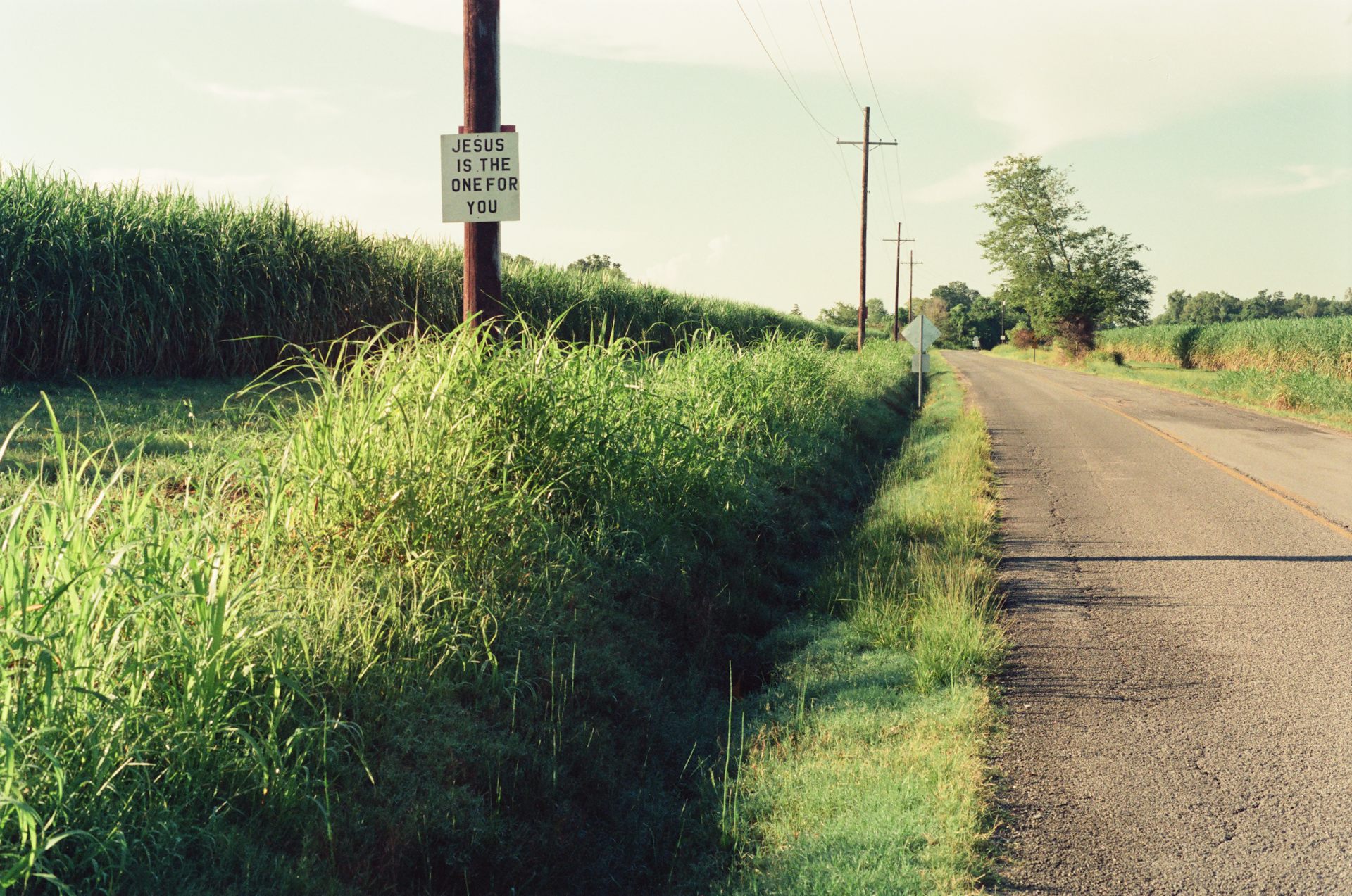
“Look No Further!” a billboard on the side of the highway beckons, drawing my gaze toward the red cover of a Bible. “You Are Worthy of Redemption!”
Not far away, another sign urges me to “Keep Christ in Christmas.” Then farther down the road a third appears: “Jesus: COMING SOON” its bright colors announce.
Signs like these are familiar to me: I’m a historian who studies the U.S. South and lives in it. I know how easily they can evoke the South – or, I should say, a certain image of it. As that image pictures it, the South is “the Bible Belt”: a place where people are really religious, and, as a result, socially and politically conservative. Indeed, in this year of midterm elections, you’re almost certain to hear pundits invoke “the Bible Belt” as shorthand explanation for Southern political behavior.
The phrase has been around for a century. Its endurance, however – and the “evidence” behind it today – could use some serious scrutiny. I spotted those roadside signs, for example, in Ontario, Canada, a thousand miles from what anybody would think of as the South.
Of the many things said about the South over the years, “Bible Belt” is the cliché that just won’t die.
Skewering the South
“Bible Belt” entered the lexicon in 1924, in the pages of The American Mercury, a magazine co-founded by H.L. Mencken. Based in Baltimore, at the upper edge of the South, Mencken was one of the nation’s most prominent journalists in the decades between the world wars.
The acerbic satirist had skewered the South in his much-discussed 1919 essay “The Sahara of the Bozart,” depicting it as a vast cultural wasteland. In 1925, he closely covered the Dayton, Tennessee, trial of biology teacher John T. Scopes, who had been charged with violating the state’s law against teaching Charles Darwin’s theory of evolution. Mencken famously lampooned it as the Scopes “monkey trial.”
He coined “Bible Belt” in his regular column of short news items, then employed the phrase routinely. By it he meant a place where two Protestant groups, the Baptists and the Methodists, dominated not just religious life, but also the mores of the whole society. The whole region, Mencken argued, was a Baptist-Methodist stranglehold where fun and free thought were banished.
Whose Christianity?
It’s true that in the early 20th century, Baptists and Methodists dominated the South in a way that they didn’t anywhere else. To trace the bloc of states where over 50% of religious congregation members were Baptist or Methodist was to trace the region’s boundaries with uncanny precision.
But beneath commonalities, religious life was divided by both race and class. Black Baptists and Methodists met in their own churches: autonomous institutions that came to be known, collectively, as “the Black church.” The region’s poor Christians drew on inherited traditions and their own hardships to craft a folk version of Baptist-Methodist faith – what I’ve written about as “hard, hard religion.”
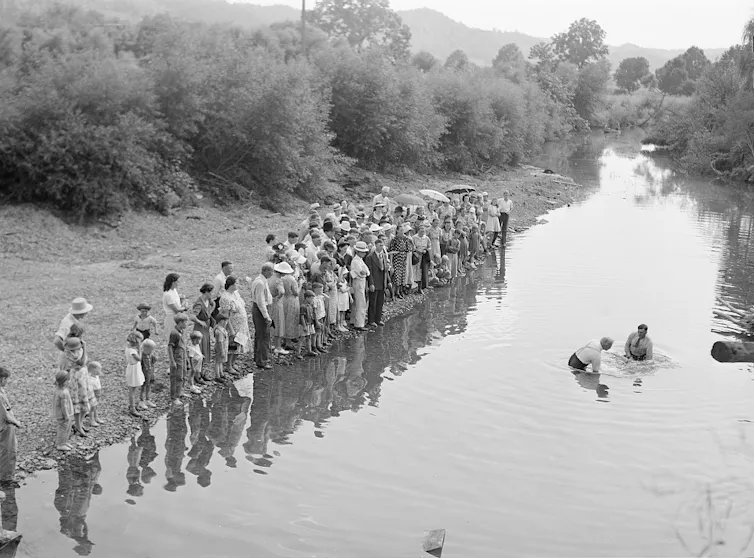
These religious divisions paralleled political ones. Through techniques like poll taxes and literacy tests, Southern states severely restricted the franchise, effectively stripping Black and poor white Southerners of their voting rights.
The social order that Mencken described as the Bible Belt, then, expressed the culture of elite and middle-class white people, the ones with the political power to enforce it.
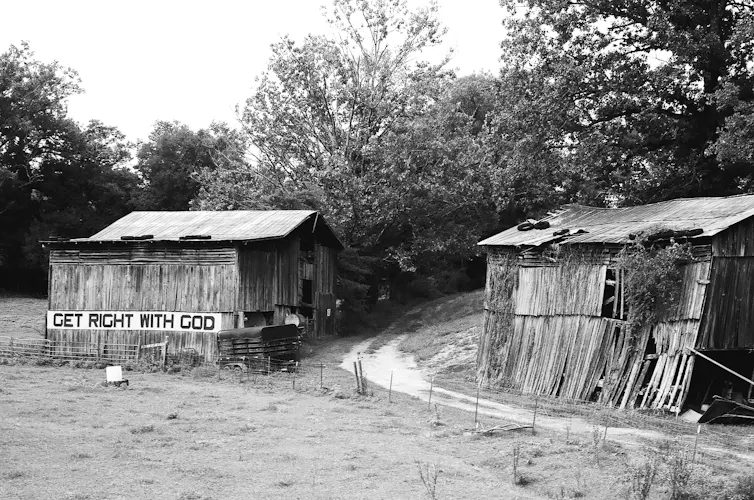
“Bible Belt” joined other phrases that expressed how the early 20th-century South differed from national patterns. Amid industrializing, urbanizing America, the South was “the Cotton Belt,” the world’s leading cotton producer, with a predominantly rural, agricultural population. Political contests marked the nation, but in the “Solid South,” the Democratic Party monopolized politics. With high poverty, low wages and limited capital, the South was the prosperous nation’s “No. 1 economic problem,” as President Franklin Roosevelt put it in 1938. And the violent racial oppression of the “Jim Crow South” was what many Black Southerners eagerly fled when doors of opportunity opened in other regions.
A new South
A century later, so much has changed.
Most Southerners, like most Americans, live in suburbs and work in a service economy. Republicans hold a political majority in the region, but they have to compete for it. Southern-based corporations like Walmart, McKesson and Exxon Mobil are in the top 10 of the Fortune 500. And what legal scholar Michelle Alexander calls “the New Jim Crow” – the system of mass incarceration that disproportionately criminalizes people of color – is not confined to the South, but nationwide.
Old lines of difference between the South and the rest of the nation have faded. So have the once-common nicknames that described them – with the stubborn exception of “Bible Belt.”
A quick glance at the news shows its persistence, with headlines discussing “The Bible Belt’s Beliefs About Women,” or describing one Arkansas town as “the Bible Belt’s LGBTQ Oasis.”
The cultural issues reported in stories like these are no doubt real, but framing them as expressions of an enduring Southern Bible Belt seems to imagine religion as unchanging, timeless.
In reality, both the region’s people and their religion are changing dramatically. More Black, Latino and biracial people live in the South than in any other part of the country. White people make up just 52.5% of the regional population. The rapidly changing South is dynamic, second only to the West in demographic diversity.
This shapes religion, too. As the 2023-2024 Pew Religious Landscape Study showed, Black and Latino Americans are more likely than white Americans to identify as Christian. The faith of Black Southerners (predominantly Baptist) and Latino Southerners (predominantly Catholic) is a reminder that the South is not a religious monolith.
Meanwhile, white Baptists and Methodists are not the force they used to be. Their main institutions, the Southern Baptist Convention and the United Methodist Church, have been declining in membership for decades. The same Pew study showed that a mere 12% of Southerners identify with either denomination.
From ‘Bible Belt’ to ‘culture wars’
Internally, both denominations have had major splits on whether women can be leaders and whether to recognize LGBTQ identities. Such splits reflect divides that sociologist James Davison Hunter diagnosed in 1991 as “Culture Wars.”
Consider his book’s subtitle, though: “The Struggle to Define America.” In these culture wars, the battlefield is the nation. The fighters are not regions, but political factions. What they’re fighting over is the legacy of the social movements of the 1960s: civil rights, women’s rights, gay rights, the environment.
The fact that the culture wars for America can be found in the contemporary South is a testament to just how much the once-distinct region participates in the dynamics of national life. Those wars may sound louder in the South than elsewhere, but that’s not the expression of a changeless Bible Belt; rather, it is the historical pattern that reactions are often strongest where change is most pronounced.
John Hayes, Associate Professor of History, Augusta University
This article is republished from The Conversation under a Creative Commons license.
Leave a Reply