
A new psychology study suggests that effort can improve understanding but does not necessarily make learning more enjoyable.
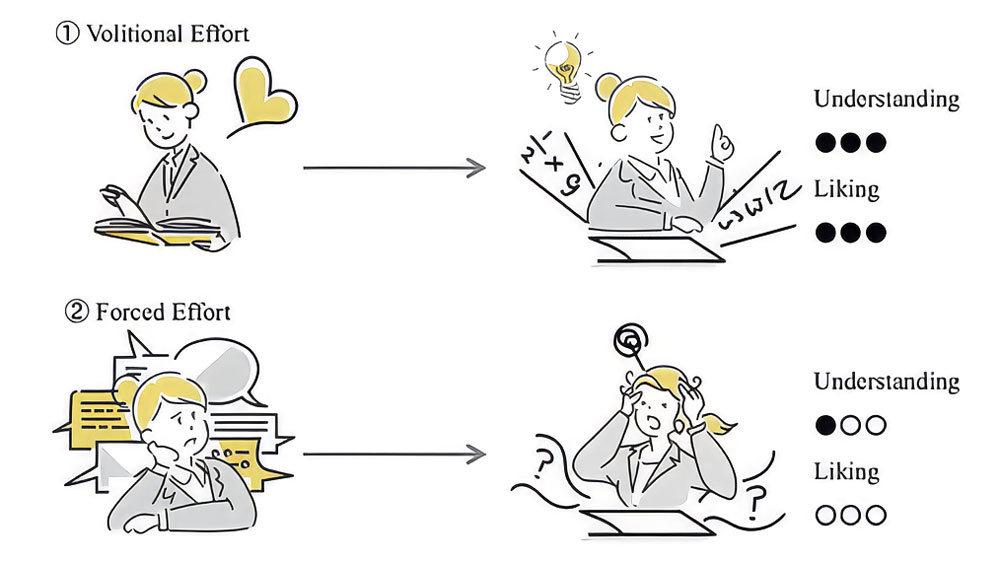
As children, many of us resisted being told that studying harder would make learning enjoyable, especially when struggling with math homework. Yet as adults, we may give children the same advice. But does effort really lead to interest, or is it the other way around?
A new psychology study from Kyushu University suggests that working harder does not necessarily make material more enjoyable. Instead, interest and liking may motivate people to engage in the first place. The findings were published in Acta Psychologica on September 30, 2026.
“I’m curious if a student is made to work harder, does that bring the same benefits as effort they choose to give,” asks Yimeng Jin, a PhD student at Kyushu University’s Graduate School of Systems Life Sciences and the paper’s first author. “It matters because many learning environments rely on required effort, such as assignments, on the assumption that more effort is always better.”
To investigate, the team conducted three experiments involving 110 students at Kyushu University. They designed a task that required participants to actively construct meaning rather than simply absorb information. Participants read pairs of random, seemingly unrelated sentences and chose whether to explain how they might be connected. By tracking their choices, completion, and time spent, the researchers could separate two aspects of effort: willingness to engage and cognitive effort invested. After each task, participants rated how much sense the sentences made together, how interesting they were, and how much they liked them.
In the first experiment, participants who chose to explain the sentences did so, while those who opted out skipped the task. As might be expected, those who explained gave higher ratings for understanding, interest, and liking. But was this because they had made more effort, or because they already found the sentences interesting?
To find out, the second experiment introduced a twist. Some pairs that participants wanted to explain were randomly selected to be prevented from doing so. Even without completing the task, participants still rated the material as more enjoyable than those who chose to skip it. Explaining improved their sense of understanding, but not their interest or liking. This suggests that positive feelings may have encouraged engagement rather than resulted from it.
The third experiment reversed the situation. Some pairs that participants initially chose to skip the explanation were randomly selected to require an explanation. The results showed that their sense of understanding improved, although less than when participants chose to explain voluntarily, their interest and enjoyment did not significantly change.
“Interestingly, participants who were required to explain spent more time on the task than those who chose to do so,” adds Jin. “Perhaps they initially skipped it because the sentences were harder to understand, so they needed more time to make sense of them. It’s a bit like struggling through homework in a subject you don’t enjoy. Together, the experiments suggest that effort can help people make sense of information, while interest is more closely linked to their willingness to engage.”
The researchers note that the findings may not fully reflect everyday learning, as the experiments involved university students completing short reading tasks rather than younger learners in classrooms. Looking ahead, the team plans to explore these questions in more natural educational settings and over longer periods. They hope the findings can encourage educators and parents to think about how to help children develop a genuine interest in what they are learning.
“The findings have implications far outside education. The connection between engagement and effort is key whenever our understanding depends on reading texts,” concludes Professor Johan Lauwereyns at Kyushu University’s Faculty of Arts and Science.
Leave a Reply